How to Register a Business Name in Kenya in 2026: The Complete Step-by-Step Guide
Get High Paying Surveys
Earn money online by completing simple surveys. No experience needed.
Start Earning →Quick Summary
- Register a business name in Kenya through the eCitizen portal at ecitizen.go.ke under the Business Registration Service (BRS)
- The process is fully online — no need to visit a government office for most business types
- Registration fees start at KES 950 for a sole proprietorship or partnership business name
- A business name search must be done first to confirm your preferred name is available
- Processing takes 3 to 7 working days after payment and document submission
- You must have a KRA PIN and an active eCitizen account before you start
- This guide covers sole proprietorships, partnerships, and limited liability companies (LLCs)
Introduction: Why Registering Your Business Name Matters
You have a business idea, a product to sell, or a service to offer. You have already started telling people about it. But until your business name is officially registered with the government of Kenya, you are operating informally — and that comes with real risks.
An unregistered business cannot open a dedicated business bank account. It cannot apply for government tenders. It cannot legally enter into contracts. It cannot get a business permit from the county government. And if someone else registers the same name before you, you lose the right to use it — even if you have been using it for years.
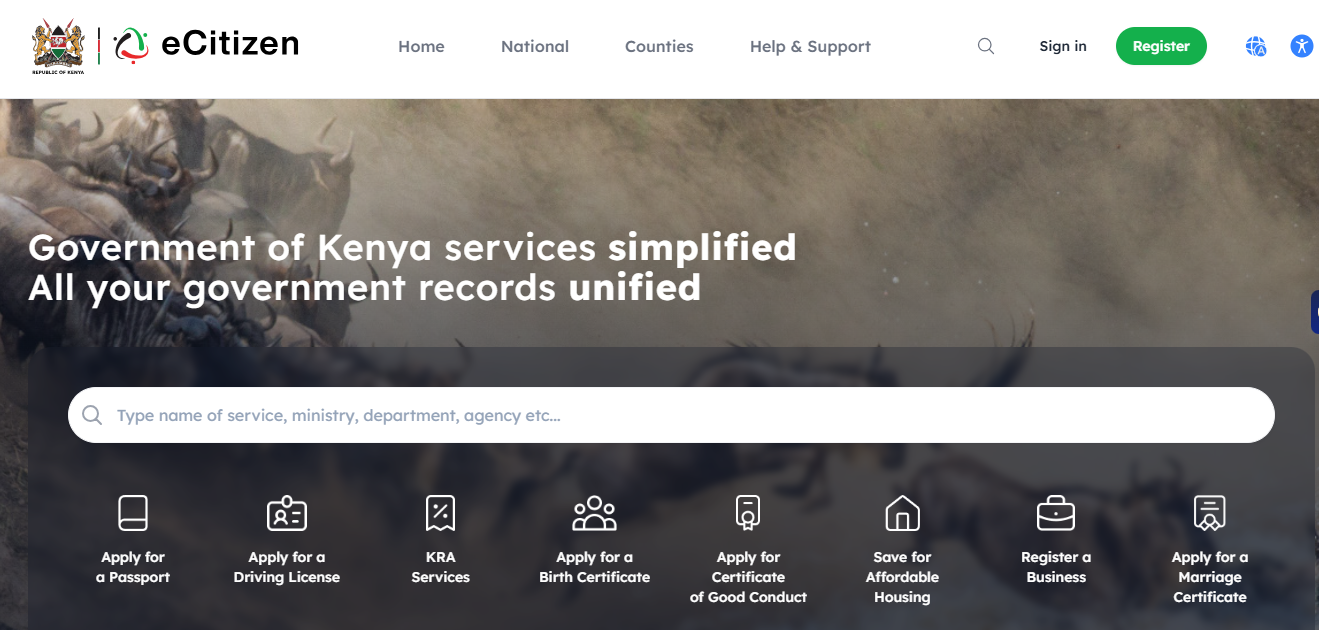
Knowing how to register a business name in Kenya is one of the most practical things an entrepreneur can do. In 2026, the entire process runs through the eCitizen platform, and for most business types, you never have to leave your house.
This guide walks you through every step — from the business name search to receiving your registration certificate.
Business Structures in Kenya: Which One Are You Registering?
Before you begin, you need to know what type of business you are registering. The process and fees differ depending on your structure.
Sole Proprietorship — This is the simplest and most common structure in Kenya. It is owned and run by one person. The business name and the owner are legally the same entity — meaning the owner is personally liable for any debts. Examples: a shop, a salon, a freelance service, a hardware store. Most small businesses in Kenya start here.
Partnership — Two or more people running a business together under a shared business name. Like a sole proprietorship, partners are personally liable. A partnership deed is advisable (though not legally required for registration) to document each partner’s rights and responsibilities.
Limited Liability Company (Private Limited — Ltd) — A separate legal entity from its owners (shareholders and directors). The company can own property, enter contracts, and sue or be sued in its own name. Liability is limited to each shareholder’s investment. This is the structure for more serious or growing businesses. Registered as a company, not just a business name.
Limited Liability Partnership (LLP) — A hybrid between a partnership and a limited company. Partners have limited liability. Less common than the above three but available through BRS.
This guide covers the full process for sole proprietorships and partnerships in detail, and outlines the key differences for company registration.
What You Need Before You Start: Requirements
For Sole Proprietorship and Partnership Registration
- eCitizen account (create one at ecitizen.go.ke if you do not have one)
- KRA PIN — mandatory. If you do not have one, get it first at itax.kra.go.ke
- National ID (for Kenyan citizens) or passport (for foreign nationals)
- Proposed business name(s) — have two or three options ready in case your first choice is taken
- Physical business address — the location where the business will operate
- Postal address — a P.O. Box or official mailing address
- Nature of business — a brief description of what the business does (e.g., “retail sale of electronics” or “provision of graphic design services”)
- For partnerships: full names, ID numbers, KRA PINs, and addresses of all partners
For Limited Company Registration (Additional Requirements)
- Proposed company name (must end with “Limited” or “Ltd”)
- Memorandum and Articles of Association — this can be the standard template provided on eCitizen or a customised one drafted by an advocate
- Details of all directors — names, national IDs, KRA PINs, physical addresses, and nationalities
- Details of all shareholders — names, IDs, and number of shares allotted to each
- Share capital structure — the total authorised share capital and how it is divided
- Registered office address in Kenya
Step 1: Do a Business Name Search First
Before you pay anything, you must confirm that your preferred business name is not already taken. Registering a name that already exists will lead to rejection and you will waste your money.
How to Do a Business Name Search on eCitizen

- Go to ecitizen.go.ke and log in to your account
- On the dashboard, search for “Business Registration Service” or click on it from the ministry listings
- Select “Business Name Search” from the available services
- Type your proposed business name in the search box
- The system will show you whether the name is available, already taken, or too similar to an existing name
If your first choice is taken, try variations:
Get High Paying Surveys
Earn money online by completing simple surveys. No experience needed.
Start Earning →- Add a descriptor (e.g., “Sunrise Enterprises” becomes “Sunrise Global Enterprises”)
- Add your town or county (e.g., “Mombasa Sunrise Enterprises”)
- Rethink the name entirely
A business name search on eCitizen is free and takes less than a minute.
Naming Rules to Keep in Mind
Your business name will be rejected if it:
- Is identical or confusingly similar to an existing registered name
- Contains words implying government affiliation (e.g., “National,” “Kenya Government,” “Authority”) without approval
- Is offensive, misleading, or contrary to public interest
- Contains restricted words like “Bank,” “Insurance,” “Trust,” or “University” without the relevant regulatory approval
- Is too generic (e.g., just “Shop” or “Business”)
Choose a name that is unique, professional, and clearly related to your business activity.
Step 2: Log In to eCitizen and Navigate to BRS
Once you have confirmed your business name is available:
- Go to ecitizen.go.ke and log in
- On the services dashboard, click on “Business Registration Service (BRS)”
- You will see a list of registration services. Select the one matching your business type:
- “Business Name — Sole Proprietorship” for a one-person business
- “Business Name — Partnership” for a two-or-more-person business
- “Company — Private Limited Company” for an LLC
Step 3: Fill in the Business Registration Form
This is the main application form. The fields vary slightly by business type, but for a sole proprietorship, you will fill in:
Business Details:
- Business name (exactly as confirmed in your name search)
- Nature of business / business activity (be specific — write “retail sale of mobile phones and accessories” rather than just “electronics”)
- Physical address of the business (county, town, building, street)
- Postal address
Owner / Proprietor Details:
- Full name (as on your national ID)
- National ID number
- KRA PIN
- Date of birth
- Residential address
- Phone number and email address
For Partnerships: Repeat the proprietor section for each partner. Each partner’s details — name, ID, KRA PIN, address — must be entered separately.
Fill everything carefully. The name on the form must match your national ID exactly. The business name must match what cleared in the name search.
Step 4: Upload Required Documents
After filling the form, the system will prompt you to upload supporting documents. For a sole proprietorship, you typically need:
- Copy of national ID (front and back, scanned or photographed clearly)
- KRA PIN certificate (download it from iTax as a PDF)
- For foreign nationals: copy of passport and alien ID
For a partnership, each partner must provide:
- Copy of national ID or passport
- KRA PIN certificate
For a limited company:
- Copies of all directors’ national IDs
- KRA PIN certificates for all directors and shareholders
- Memorandum and Articles of Association
Upload files in JPG, PNG, or PDF format. Keep each file under 2MB. Make sure scanned documents are clear — cut-off or blurry uploads will be rejected.
Step 5: Pay the Registration Fee
After uploading documents, the system will prompt you to pay. Government registration fees in 2026:
| Business Type | Registration Fee |
|---|---|
| Sole Proprietorship (business name) | KES 950 |
| Partnership (business name) | KES 950 |
| Private Limited Company | KES 10,650 (standard share capital) |
| Limited Liability Partnership (LLP) | KES 10,650 |
| Annual renewal — Sole Proprietorship / Partnership | KES 950 |
Note: Company registration fees vary based on the nominal share capital. The figure above applies to companies with a standard share capital. Higher share capitals attract higher fees. Fees may be updated by BRS — always confirm the exact amount on eCitizen before paying.
Payment methods accepted:
- M-Pesa (Lipa na M-Pesa Paybill — the number is shown on the eCitizen payment page)
- Debit or credit card
- Airtel Money
After payment, you will receive an eCitizen payment receipt and a reference number. Save this.
Step 6: Wait for Processing and Approval
After payment and document submission, the Business Registration Service will review your application. This takes:
- Sole Proprietorship / Partnership: 3 to 5 working days
- Private Limited Company: 5 to 7 working days
- During peak periods (end of year, start of year): may take up to 10 working days
You can track your application status by logging in to eCitizen and going to “My Applications.” The status will update from “Pending” to “Approved” or “Awaiting Corrections” if something needs to be fixed.
You will also receive an email and SMS notification when your application is approved.
Step 7: Download Your Certificate of Registration
Once approved, log in to eCitizen, go to your completed applications, and download your Certificate of Registration as a PDF.
For sole proprietorships and partnerships, this is the Certificate of Registration of Business Name — the official document proving your business is legally registered.
For limited companies, you will receive:
- Certificate of Incorporation
- CR12 (list of directors and shareholders)
- Memorandum and Articles of Association (stamped)
Print the certificate and keep the original safely. You will need it to:
- Open a business bank account
- Apply for a business permit from your county government
- Register for business taxes (VAT, Turnover Tax) on iTax
- Apply for tenders and contracts
- Register with professional bodies or regulators (if applicable)
Company Registration Fees in Kenya: Full Breakdown
Here is a more detailed breakdown of what to expect when registering a private limited company, including associated costs beyond the BRS fee:
| Item | Estimated Cost |
|---|---|
| BRS registration fee (standard) | KES 10,650 |
| Memorandum and Articles of Association (if using advocate) | KES 5,000–15,000 |
| CR12 extraction (after registration) | KES 650 |
| Company seal (optional but useful) | KES 2,000–4,000 |
| Bank account opening (varies by bank) | Usually free |
| Business permit — county (annual) | KES 5,000–20,000+ depending on county and business type |
| Estimated total (company setup) | KES 18,000–40,000+ |
For a sole proprietorship, your total cost is much simpler: KES 950 for registration plus a county business permit fee.
After Registration: What to Do Next
Registering your business name is just the beginning. Here is what you should do immediately after:
1. Register for the relevant tax obligations on iTax Log in to iTax, go to “Registration” > “Amend PIN Details,” and add the appropriate tax obligations for your business. Most small businesses start with Turnover Tax (TOT) if their annual revenue is below KES 25 million, or Income Tax — Business for larger operations. If you expect to turn over more than KES 5 million per year, you must also register for VAT.
2. Open a business bank account Take your Certificate of Registration, national ID, and KRA PIN to your bank of choice. Most Kenyan banks — Equity, KCB, Cooperative Bank, NCBA, Absa — offer business accounts specifically for small businesses. Some have no minimum balance requirements.
3. Apply for a county business permit Every business operating physically in Kenya needs a single business permit from the county government where it is located. Apply through your county’s online portal (many counties now have eCitizen integration) or visit the county headquarters. Fees vary by county and business type.
4. Register for NHIF/SHA and NSSF (if you have employees) If you are employing anyone, you are legally required to register as an employer with NHIF/SHA (Social Health Authority) and NSSF. This can be done on eCitizen.
5. Keep your business name renewed Business name registrations for sole proprietorships and partnerships must be renewed annually for KES 950. Set a reminder — operating under an expired registration is an offence under the Business Registration Act.
Common Mistakes to Avoid
1. Not doing a name search before paying Many applicants pay the registration fee and then discover their name is already taken. The system does not refund you. Always search first — it is free.
2. Using initials or abbreviations in the business name that conflict with existing names “JKM Enterprises” might not be available if “JK Enterprises” or “JKM Holdings” already exists. Be creative with your name.
3. Entering a name on the form that is different from the one that cleared in the search Even a small spelling difference between the name in your search and the name on your form will cause rejection. Copy and paste if possible.
4. Uploading low-quality ID scans Dark, blurry, or cut-off ID images are a top cause of rejection. Scan in good lighting and ensure all four corners of the ID are visible.
5. Not renewing the business name annually Sole proprietorship and partnership business names must be renewed every year. Many Kenyans forget this, which eventually leads to their name being de-registered and potentially picked up by someone else.
6. Registering as a sole proprietorship when you need a company If you are raising investment, bringing in co-owners with limited liability, or dealing with large contracts, a sole proprietorship will not serve you well. A private limited company is a separate legal entity and offers far more protection and credibility.
7. Using a personal email for company communications When registering a company, use a business email (e.g., info@yourcompany.co.ke) as the contact. This looks professional to banks, clients, and regulators.
Tips to Speed Up Approval
- Apply on a Tuesday or Wednesday morning — BRS processing tends to move faster mid-week
- Upload all documents in clear, well-lit PDF format rather than phone photos
- Use exactly the same name in every field — name search, registration form, and uploaded documents
- If registering a company, have all directors’ IDs and KRA PINs ready before starting
- Use a Gmail or professional email address that you check regularly — BRS sends notifications there
- If your application shows “Awaiting Corrections,” log in immediately and address the issue — applications that sit in corrections for too long may be cancelled
Frequently Asked Questions (FAQs)
1. How long does it take to register a business name in Kenya?
For sole proprietorships and partnerships, BRS typically processes applications within 3 to 5 working days after submission and payment. For private limited companies, expect 5 to 7 working days. During peak periods the process can take up to 10 working days.
2. Can I register a business name in Kenya without a KRA PIN?
No. A KRA PIN is mandatory for business registration in Kenya. You must obtain your PIN first at itax.kra.go.ke before starting the business registration process on eCitizen.
3. What is the difference between a business name and a company registration?
A business name (for sole proprietorship or partnership) does not create a separate legal entity. The owner and the business are the same in the eyes of the law. A company registration (private limited) creates a distinct legal entity with its own rights, assets, and liabilities — separate from its directors and shareholders. For most small startups and freelancers, a sole proprietorship is sufficient. For businesses seeking investment, multiple owners, or greater legal protection, a private limited company is the better choice.
4. Do I need a lawyer to register a business name in Kenya?
For a sole proprietorship or partnership, no. You can do the entire process yourself on eCitizen. For a private limited company, you do not strictly need a lawyer, but one is recommended if your Memorandum and Articles of Association needs customising beyond the standard eCitizen template.
5. How much does it cost to register a business name in Kenya in 2026?
A sole proprietorship or partnership business name costs KES 950. A private limited company costs KES 10,650 at the standard share capital level, plus additional costs for a company seal, CR12 extraction, and county business permit. See the fee tables in this guide for a full breakdown.
6. Can a foreigner register a business in Kenya?
Yes. Foreign nationals can register a business in Kenya using their passport and alien ID. For companies, there may be restrictions on certain sectors (e.g., some activities require at least a percentage of local ownership). A foreign-owned company must also obtain a business permit from the relevant county and may need an investment certificate from the Kenya Investment Authority (KenInvest).
7. What happens if I do not renew my business name registration?
Your business name registration will lapse. An expired registration means you are technically operating without a valid registration — which is an offence. The name may eventually be de-registered and become available for someone else to claim. Renewals cost KES 950 annually for sole proprietorships and partnerships.
Conclusion: Start Your Business the Right Way
Registering your business name is not just a legal formality — it is the foundation everything else is built on. Your bank account, your business permits, your tax compliance, your tenders, your contracts — all of it starts with a valid registration certificate.
The process has never been easier. Go to ecitizen.go.ke, do your name search, fill the form, pay KES 950, and within a week you will have a Certificate of Registration in your hands.
If you are serious about growing your business, take that step today. A registered business is a real business.
Read also:
- How to File KRA Returns Online
- How to Apply for KRA PIN Online
- How to Apply for a Driving License in Kenya
Get High Paying Surveys
Earn money online by completing simple surveys. No experience needed.
Start Earning →