How to Register a Company in Kenya in 2026 (Complete Step-by-Step Guide)

Get High Paying Surveys
Earn money online by completing simple surveys. No experience needed.
Start Earning →Quick Summary
Registering a company in Kenya is done through the Business Registration Service (BRS) via the eCitizen portal at ecitizen.go.ke.
The process is fully online — from name search to certificate issuance — and takes 3 to 7 working days for a private limited company when all documents are correctly submitted. The cost starts at KES 10,650 for a private limited company.
This guide covers every business structure available, the exact documents you need, a step-by-step walkthrough of the eCitizen company registration process, post-registration requirements, and how to get your CR12 certificate.
What Is Company Registration and Why Does It Matter in Kenya?
Registering a company in Kenya gives your business a separate legal identity from yourself as an individual. This means the company can own property, enter contracts, sue and be sued, and open bank accounts — all in its own name.
Beyond the legal protection, a registered company in Kenya is required for:
- Opening a business bank account — banks require a Certificate of Incorporation and other company documents
- Applying for government tenders — the Public Procurement and Asset Disposal Act requires registered entities
- Signing contracts with corporate clients — most medium and large companies will not do business with unregistered entities
- Importing and exporting goods — Kenya Revenue Authority (KRA) requires a registered entity for trade licenses
- Attracting investors — investors and venture capital firms can only invest in properly registered companies
- Accessing business loans — banks and SACCOs require company registration documents
Operating a business without registering it is not illegal for sole traders, but it severely limits your growth, credibility, and access to formal financing.
Types of Business Structures in Kenya
Before you register, you must decide what type of business entity suits your needs. Each has different legal implications, tax obligations, and registration requirements.
1. Private Limited Company (Ltd)
The most popular structure for SMEs and startups. A private limited company:
- Has between 1 and 50 shareholders
- Shareholders have limited liability — personal assets are protected if the company incurs debts
- Cannot offer shares to the general public
- Requires at least one director who must be a natural person
- Is a separate legal entity from its owners
Best for: Entrepreneurs, SMEs, startups, and any business planning to scale, seek investment, or win tenders.
2. Public Limited Company (PLC)
- Can have unlimited shareholders
- Can offer shares to the public (e.g., list on the Nairobi Securities Exchange)
- Subject to stricter regulatory requirements under the Companies Act, 2015
Best for: Large established businesses planning to raise capital from the public.
3. Sole Proprietorship
- Owned and run by one individual
- No separation between the owner and the business — you are personally liable for all debts
- Registered through BRS but much simpler than a limited company
- Does not result in a Certificate of Incorporation — you receive a Business Name Certificate instead
Best for: Freelancers, small traders, and individuals running low-risk personal businesses.
Get High Paying Surveys
Earn money online by completing simple surveys. No experience needed.
Start Earning →4. Partnership
- Two or more people running a business together
- Can be a general partnership (all partners equally liable) or a limited partnership (some partners have limited liability)
- Registered as a business name under the BRS
Best for: Professional practices (law firms, accounting firms) and small joint ventures.
5. Limited Liability Partnership (LLP)
- Combines features of a partnership and a limited company
- Partners have limited liability
- Must have at least two partners
- Increasingly popular among professional service providers
6. Company Limited by Guarantee
- Does not have share capital — members guarantee a nominal amount in case of winding up
- Common for NGOs, associations, churches, and professional bodies
Best for: Non-profit organisations and member associations.
This guide focuses primarily on registering a Private Limited Company, as it is the most commonly sought structure by Kenyan entrepreneurs. Steps for other structures are noted where they differ significantly.
Requirements for Registering a Company in Kenya
Documents and Information You Need
For Each Director and Shareholder
- National ID (for Kenyan citizens) or Passport (for foreign nationals)
- KRA PIN certificate — mandatory for all directors and shareholders who are Kenyan residents
- Passport-size photo
- Residential address (physical address, not a P.O. Box)
- Email address and phone number
For the Company Itself
- Proposed company name — have at least 3 options ready in order of preference, in case your first choice is taken
- Nature of business — a brief description of what the company will do (its objects)
- Registered physical address of the company (where official correspondence will be sent)
- Share structure — how many shares the company will issue and how they will be distributed among shareholders
- Memorandum and Articles of Association (M&AA) — BRELA provides a standard template you can use, or you can have a lawyer draft a custom one
Minimum Requirements for a Private Limited Company
- Minimum 1 director (no maximum, but at least one must be a natural person — not a corporate entity)
- Minimum 1 shareholder (can be the same person as the director)
- Minimum share capital: No minimum prescribed share capital under the Companies Act, 2015. However, a nominal share capital of KES 100,000 (100,000 shares at KES 1 each) is common practice
- A company secretary (required within 30 days of incorporation for companies with more than one director — optional for single-director companies)
Company Registration Fees in Kenya (2026)
| Service | Fee (KES) |
|---|---|
| Name reservation | KES 150 |
| Registration of private limited company | KES 10,500 |
| Certificate of Incorporation | Included |
| CR12 (Official Search / Letter of Directors) | KES 650 |
| Business Permit (county government — separate) | Varies by county |
| KRA PIN for company | Free |
| VAT registration | Free |
The total government fee to incorporate a private limited company is approximately KES 10,650 (name reservation + registration fee). If you use a lawyer or company secretary to assist, professional fees are additional and vary widely — budget KES 5,000 to KES 30,000 depending on the firm.
How to Register a Company in Kenya — Step-by-Step (eCitizen)
The entire process is done through eCitizen. You do not need to visit any government office unless there is a specific issue with your application.
Step 1: Create or Log In to Your eCitizen Account
Go to ecitizen.go.ke and log in. If you do not have an account:
- Click “Create Account”
- Enter your National ID number, full name, date of birth, and phone number
- Create a password
- Verify your account using the OTP sent to your phone
Once logged in, you will see the eCitizen services dashboard.
Step 2: Navigate to Business Registration Service (BRS)
On the eCitizen dashboard, scroll through the government agencies listed and click on “Business Registration Service” (sometimes listed as “BRS”). This opens the BRS portal within eCitizen.
Step 3: Reserve Your Company Name
Before filing for incorporation, you must first reserve your company name. This confirms the name is available and locks it for your use during the registration process.
- Under BRS services, click “Limited Liability Partnerships / Companies” → “Company Name Search and Reservation”
- Enter your preferred company name in the search field
- The system will check whether the name is available
- If available, click “Reserve Name”
- Pay the name reservation fee of KES 150 via M-Pesa (use the Paybill and reference generated on screen)
- Your name reservation is valid for 30 days — you must complete incorporation within this period
Tips for choosing a company name:
- The name must end with “Limited” or “Ltd” for a private limited company
- Avoid names that are identical or confusingly similar to existing registered companies
- Avoid names that imply government affiliation (e.g., “Kenya National…” or “Government of…”)
- Avoid names with offensive words or misleading descriptions
- If your first choice is taken, submit your second preference — do not restart the process
Step 4: File for Incorporation
Once your name is reserved, return to the BRS dashboard and select “Incorporate a Company.”
You will be taken through a multi-step online form. Fill in each section carefully:
Section A — Company Details
- Reserved company name (auto-filled from your reservation)
- Company type: select “Private Company Limited by Shares”
- Nature of business / business objects (e.g., “General trade, consultancy, and IT services”)
- Registered physical address of the company
- Postal address (P.O. Box)
- Email address and phone number for the company
Section B — Share Capital
Enter the share structure:
- Total number of shares (e.g., 1,000 shares)
- Nominal value per share (e.g., KES 100 per share = KES 100,000 total share capital)
- Currency: KES
Then allocate shares to each shareholder. For each shareholder, enter:
- Full name
- National ID or Passport number
- Number of shares allocated
- Percentage of shareholding
Example: A company with two shareholders — Person A holds 600 shares (60%) and Person B holds 400 shares (40%).
Section C — Directors
Enter details for each director:
- Full name
- National ID or Passport number
- KRA PIN
- Date of birth
- Residential address
- Occupation
- Phone number and email
A person can be both a shareholder and a director — this is very common in Kenyan SMEs.
Section D — Upload Documents
Upload the following for each director and shareholder:
- Copy of National ID (front and back) or passport
- KRA PIN certificate
- Passport photo
Also upload:
- Memorandum and Articles of Association (M&AA) — you can download the standard template from the BRS portal and use it without modification, or upload a custom one prepared by a lawyer
Step 5: Review and Submit
Go through the full application summary. Check every name, ID number, share allocation, and address for errors. Mistakes at this stage cause delays that require formal correction applications later.
Once satisfied, click “Submit Application.”
Step 6: Pay the Registration Fee
After submission, the system generates a payment reference. Pay the KES 10,500 registration fee via:
- M-Pesa Paybill: Use the Paybill number and account reference displayed on your eCitizen screen
- Credit/Debit card: Visa and Mastercard are accepted on eCitizen
- eCitizen wallet: If you have a funded eCitizen wallet, you can pay directly from it
Keep your M-Pesa confirmation message or payment receipt.
Step 7: Wait for BRS Processing
After payment, your application is reviewed by BRS officers who verify:
- That all directors and shareholders’ IDs are genuine
- That the company name is properly reserved
- That documents are correctly uploaded and complete
- That the M&AA conforms to the Companies Act, 2015
Processing takes 3 to 7 working days for a straightforward private limited company application. If BRS has queries, they will contact you via the email address registered on eCitizen.
Check your application status by logging into eCitizen → BRS → “My Applications.”
Step 8: Download Your Certificate of Incorporation
Once approved, you will receive an email and SMS notification. Log in to eCitizen and download your:
- Certificate of Incorporation — confirms the company is legally registered and shows the company registration number (e.g., PVT-XXXXXXXX)
- CR1 (Memorandum and Articles of Association confirmation)
- CR2 (Statement of Nominal Capital)
- CR8 (Particulars of Directors)
These documents are issued digitally with a QR code for verification. They are legally valid without a physical stamp. Print and store copies securely.
Post-Registration Steps (What to Do After Getting Your Certificate)
Getting your Certificate of Incorporation is not the end — it is the beginning. Here are the critical steps to take immediately after registration:
1. Apply for a Company KRA PIN
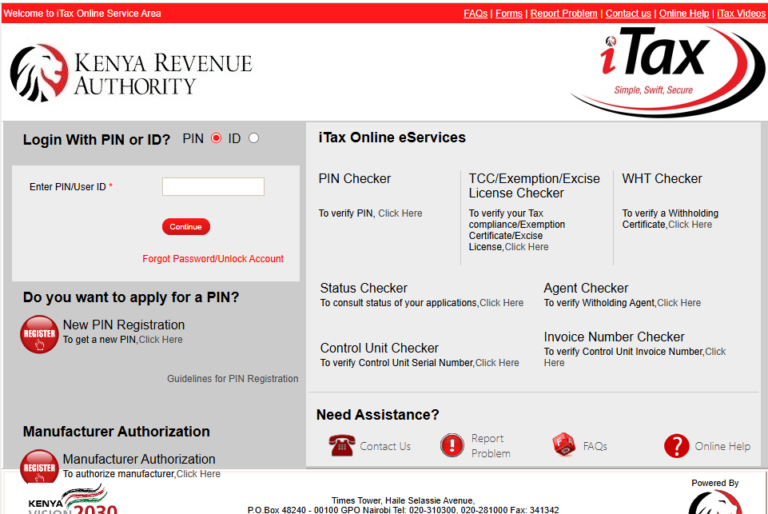
A company needs its own KRA PIN separate from the directors’ personal PINs. Apply via itax.kra.go.ke:
- Log in using your personal KRA credentials
- Select “New PIN Registration” → “Non-Individual”
- Enter the company registration number and Certificate of Incorporation details
- Upload the Certificate of Incorporation and director IDs
- Submit — the company KRA PIN is issued immediately or within 24 hours
See also: How to Apply for a KRA PIN in Kenya
2. Register for VAT (If Applicable)
If your company’s annual turnover will exceed KES 5,000,000, you are required to register for VAT on iTax. Even if below this threshold, voluntary VAT registration can be beneficial for B2B businesses.
3. Open a Business Bank Account
Take the following to your preferred bank’s business banking desk:
- Certificate of Incorporation
- CR12 (see below)
- Company KRA PIN certificate
- Directors’ National IDs and personal KRA PINs
- Board resolution authorising account opening (your bank will provide the template)
Most Kenyan banks (KCB, Equity, Co-operative, NCBA, Absa, Stanbic) have dedicated SME banking desks and can open your account within 1–3 working days.
4. Apply for a Business Permit
All companies operating in Kenya require a Business Permit (formerly known as a Single Business Permit) from the county government where the business is located. Apply through your county’s revenue portal or at the county government offices.
- Nairobi: Apply via ejijikeji.nairobi.go.ke
- Other counties: Check your specific county government website or visit the county revenue offices
Permit fees vary by county, business type, and business size — budget KES 5,000 to KES 30,000 per year for a small to medium business in Nairobi.
5. Register with NSSF and SHIF/SHA
If you plan to hire employees, you must register the company with:
- National Social Security Fund (NSSF) at nssf.or.ke — for employee pension contributions
- Social Health Authority (SHA) at shif.sha.go.ke — for employee health insurance
See also: How to Register for SHA in Kenya
What Is a CR12 in Kenya and How Do You Get One?
The CR12 is an official document issued by the Business Registration Service that lists the current directors and shareholders of a company at a given point in time. It is essentially a certified snapshot of who owns and controls a company.
Why You Need a CR12
- Bank account opening — banks require a CR12 as part of KYC (Know Your Customer) checks
- Government tenders — PPRA and most procuring entities require a CR12 not older than 30 days
- Business contracts — some corporate clients and partners request it for due diligence
- Loan applications — lenders verify directorship via CR12
- Legal proceedings — used as evidence of company ownership in disputes
How to Apply for a CR12 via eCitizen
- Log in to ecitizen.go.ke
- Navigate to “Business Registration Service”
- Select “Official Search / CR12”
- Enter the company registration number
- Pay KES 650 via M-Pesa or card
- Your CR12 is generated immediately and available for download as a PDF
The digital CR12 with a QR verification code is accepted by most institutions. Some banks and tender committees still request a physically stamped version — in that case, visit the BRS offices at Sheria House, Harambee Avenue, Nairobi or any BRS county office.
Note: A CR12 is a point-in-time document. If your directors or shareholders change after it is issued, you must apply for a new one. Most institutions require a CR12 dated within the last 30 days.
Common Mistakes to Avoid When Registering a Company in Kenya
1. Choosing a name that is too similar to an existing company The BRS name search sometimes approves names that are similar but not identical to existing companies. Before reserving a name, do a broad search yourself to make sure there is no established business with a similar name in your industry — avoiding confusion protects you from future legal disputes.
2. Using a P.O. Box as the registered address BRS requires a physical address for the registered office — a P.O. Box alone is not sufficient. Use a physical street address, even if it is your home address for now.
3. Forgetting to factor in post-registration costs Many first-time entrepreneurs focus only on the KES 10,650 BRS registration fee and are surprised by the additional costs: business permit, company KRA PIN setup, bank account requirements, and possibly a company secretary. Budget comprehensively from the start.
4. Filing incorrect share allocations Changing the shareholding structure after incorporation requires a formal process (filing a return of allotment, amending the M&AA, and notifying BRS). Get the share structure right from day one — discuss it with co-founders before filing.
5. Using the standard M&AA without reviewing it The standard template M&AA provided by BRS is legally valid but generic. If your business has specific governance needs (e.g., investor rights, drag-along clauses, veto rights for certain shareholders), have a lawyer draft a custom M&AA before incorporation.
6. Not keeping BRS records updated When directors resign, shares are transferred, or the registered address changes, you must notify BRS within 14 days by filing the appropriate change forms. Failure to do so means your CR12 and public records are outdated, which can cause problems during tender applications and audits.
Tips to Speed Up Company Registration
- Have all directors’ IDs and KRA PINs ready before starting the eCitizen form — the session may time out if you step away to collect documents
- Pre-scan and label all documents on your computer or phone (e.g., “Director1_ID_Front.jpg”) to upload quickly without confusion
- Use the standard M&AA template from BRS unless you have specific needs — custom M&AAs sometimes cause queries from BRS officers unfamiliar with non-standard clauses
- Pay the fee immediately after submission — applications that remain unpaid for more than 48 hours may be automatically cancelled
- Use Google Chrome or Firefox — eCitizen works best on these browsers
- Apply early in the week (Monday or Tuesday) — applications submitted late on Friday are often not reviewed until the following week
Frequently Asked Questions (FAQs)
1. Can one person register a private limited company in Kenya? Yes. Under the Companies Act, 2015, a private limited company can have as few as one director and one shareholder — and both can be the same person. This is known as a single-member company and is fully legal in Kenya.
2. Do I need a lawyer to register a company in Kenya? No. The eCitizen BRS process is designed for self-service and does not require a lawyer. However, if your company has multiple founders with complex shareholding arrangements, or if you need a custom M&AA, consulting a corporate lawyer is advisable. For a straightforward single or two-person company, most people complete the process without legal assistance.
3. Can a foreigner register a company in Kenya? Yes. Foreign nationals can be directors and shareholders of Kenyan companies. They must provide a valid passport instead of a National ID. For a company with foreign shareholding above 25%, additional requirements may apply under the Business Permits Act, including obtaining permits from the Kenya Investment Authority (KenInvest).
4. How long is a Certificate of Incorporation valid? A Certificate of Incorporation does not expire. Once issued, it is valid indefinitely as long as the company remains in good standing with BRS (annual returns filed, fees paid). However, annual returns must be filed every year to keep the company active.
5. What are annual returns and when must I file them? Annual returns are a mandatory yearly update filed with BRS confirming the company’s current directors, shareholders, and registered address. They are due once a year within 30 days of the anniversary of the company’s incorporation date. Filing is done via eCitizen BRS and costs approximately KES 4,750 per year. Failure to file attracts penalties and can lead to the company being struck off the register.
6. What is the difference between a business name registration and a company registration? A business name registration (for sole proprietorships and partnerships) is simpler, cheaper (around KES 950), and faster — but it does not create a separate legal entity. The owner remains personally liable for all business debts. A company registration creates a separate legal entity with limited liability protection. If you are serious about business growth, a private limited company is the better long-term choice.
7. Can I change my company name after registration? Yes. You can change the company name after incorporation by passing a special resolution at a shareholders’ meeting, then filing the resolution and a name change application with BRS via eCitizen. A fee applies. Once approved, BRS issues a Certificate of Change of Name, and you must update your KRA PIN, bank accounts, and all other registrations accordingly.
Conclusion
Registering a company in Kenya in 2026 is faster and more accessible than it has ever been. The entire process is online through eCitizen, the government fee is reasonable at around KES 10,650, and turnaround is typically less than a week for a straightforward application. The key to a smooth registration is preparation — have every director’s ID, KRA PIN, and passport photo ready before you start, agree on your shareholding structure in advance, and pay the fees promptly after submission.
Once your Certificate of Incorporation is in hand, move quickly on the post-registration steps: company KRA PIN, business permit, and business bank account. These three unlock the full commercial power of your registered company.
Start your registration today at ecitizen.go.ke under the Business Registration Service.
Get High Paying Surveys
Earn money online by completing simple surveys. No experience needed.
Start Earning →